Food Grade Protease Enzyme Supplier USA: Process Guide
Food protease for bakery doughs and protein hydrolysates: what US processors, ingredient makers and distributors should define, compare and send for a quote.

Food plants buy protease for a defined process step: working on the protein in bakery doughs, or hydrolysing plant and animal proteins into savoury bases and seasoning ingredients. This guide is for US processors, ingredient makers and distributors sourcing food-grade protease for production: what to define, how to compare offers and how to request a quote. Send the product, quantity and destination through the quote form on our home page or by email to hello@mail.enzymeb2b.com.
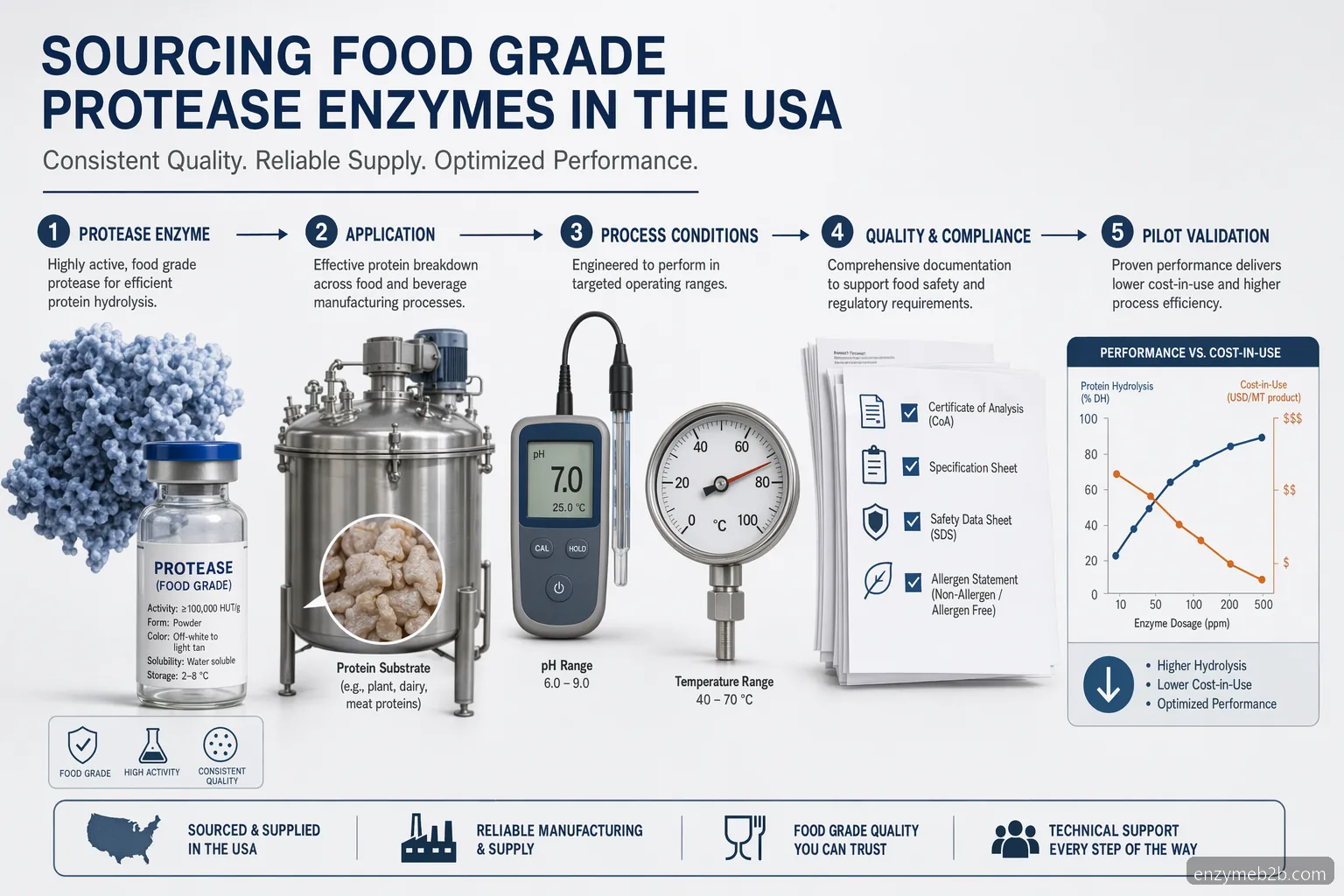
Applications: bakery doughs and protein hydrolysates
Bakery: protease is used in bakery doughs, including biscuit and cracker doughs; the grade and dose depend on the flour, the dough and the line it runs on.
Protein hydrolysates: plant and animal proteins are hydrolysed into savoury bases and seasoning ingredients, where the target is the degree of hydrolysis and a clean taste without bitterness.
Each use needs a different grade, so name the application, the substrate and the finished product in your request.
What B2B Buyers Should Define Before Sourcing
A food grade protease enzyme supplier USA search should start with process definition, not a price list. Proteases differ by source, activity profile, pH optimum, temperature tolerance, carrier system, and side activities. For general industrial food applications, buyers should identify the protein substrate, target functional change, process hold time, downstream heat step, and final product constraints. Common objectives include protein hydrolysis, viscosity reduction, flavor development, clarification support, texture modification, and improved filtration. The correct enzyme ingredient supplier will ask for substrate solids, salt level, target pH, operating temperature, and whether the enzyme must be inactivated after treatment. If your team is comparing an enzyme supplier, high activity enzyme supplier, or broader enzyme b2b marketplace listing, require comparable units and trial conditions. This prevents selecting a product that looks economical on paper but underperforms in the actual plant environment.
Define substrate protein level and solids percentage. • Document target pH, temperature, and residence time. • Confirm liquid or powder handling preference. • Identify required food grade documentation before sampling.
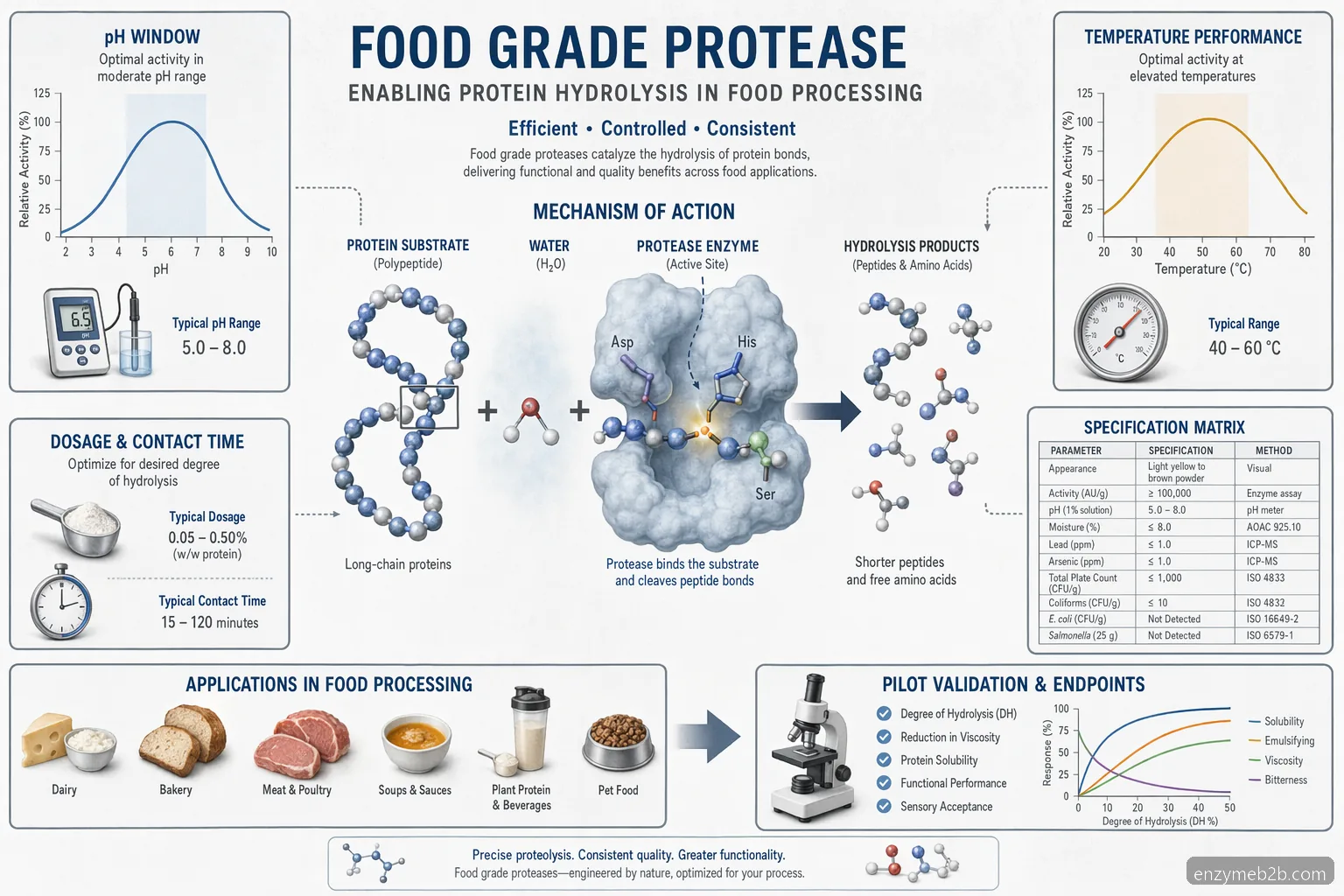
Process conditions to define before trials
Proteases differ in the pH and temperature window they work in: neutral grades suit near-neutral food systems, alkaline grades suit processes that tolerate a higher pH, and acid grades suit acidic sauces and seasonings. Rather than relying on a printed optimum, screen each candidate at your own pH, temperature and contact time, run a dose-response series instead of a single trial point, and confirm that the heat step that stops the enzyme suits the flavour, colour and texture of the finished product. A qualified protease enzyme supplier should help design the dose-response curve, define sampling intervals and recommend activity assays that match the intended process outcome.
Run pH and temperature screens before scale-up. • Use dose-response trials rather than a single trial point. • Check whether inactivation affects flavor, color, or texture. • Record viscosity, soluble nitrogen, and sensory observations where relevant.
Documentation to Request from an Enzyme Supplier
For industrial procurement, documentation is part of the product. Request a current certificate of analysis, technical data sheet, safety data sheet, ingredient statement, storage guidance, shelf-life statement, allergen information, country-of-origin details, and regulatory-use support appropriate to the destination market. If kosher or halal status is required, ask for supplier-provided documentation rather than assuming availability. A kosher halal enzyme supplier should provide current certificates for the specific item and manufacturing site when applicable. The COA should show lot number, activity value or specification range, appearance, microbiological limits when relevant, and any carrier or standardization information. The TDS should clarify activity method, recommended pH and temperature range, solubility, dosage guidance, and inactivation conditions. Use these documents to compare offers from an enzyme supplier quote request on an equal technical basis.
COA for lot-specific quality verification. • TDS for use conditions and activity method. • SDS for storage, handling, and safety review. • Kosher or halal documents only when required and current.
Pilot Validation and Cost-in-Use Evaluation
A low price per kilogram can be misleading if enzyme activity, stability, or yield improvement is lower than expected. Cost-in-use should account for dosage, activity per gram, yield impact, processing time, filtration gains, heat load, labor, waste, and rework risk. Start with bench trials using your actual substrate, water quality, pH adjustment method, and process temperature. Then run a pilot validation that mirrors plant agitation, hold time, heat transfer, and downstream separation. Compare untreated control, low dose, target dose, and high dose conditions. Track soluble protein, peptide profile if needed, viscosity, Brix or solids change, filtration rate, pH drift, microbial checks, and finished product attributes. A strong food grade enzyme supplier will support trial design and help convert activity units into practical plant dosing without making unsupported performance guarantees.
Calculate cost per treated metric ton, not only cost per kilogram. • Include yield, cycle time, and waste reduction in the model. • Confirm performance with actual plant substrate. • Keep a retained sample from each trial lot.
Supplier Qualification for Reliable Industrial Supply
Supplier qualification should combine technical fit, commercial reliability, and quality system review. Ask whether the supplier is a manufacturer, distributor, importer, or marketplace partner, because this affects lead time, change notification, and technical escalation. Review minimum order quantity, sample availability, standard packaging, pallet configuration, storage temperature, and typical lead time for USA delivery. For a high activity enzyme supplier, confirm whether the product is standardized to a consistent activity range and whether formulation changes trigger notification. If your procurement team also buys from an enzyme vitamin supplier or broader ingredient distributor, separate food processing enzyme requirements from supplement ingredient assumptions. Protease enzymes for industrial processing should be selected by application data, documentation, and pilot results. Final approval should involve R&D, QA, procurement, operations, and regulatory stakeholders.
Confirm role: manufacturer, distributor, or authorized supply partner. • Review change control and lot traceability expectations. • Check lead time, MOQ, and emergency supply options. • Align QA, R&D, procurement, and production before approval.
Request a quote
Send the application, the substrate, your process pH, temperature and contact time, the quantity for the first order and per year, the pack you want and the destination through the quote form on our home page or by email to hello@mail.enzymeb2b.com. Distributors: add the markets you sell into and the pack sizes your customers order.
Industrial Enzymes (Wholesale) for Research & Industry
Need Industrial Enzymes (Wholesale) for your lab or production process?
ISO 9001 certified · Food-grade & research-grade · Ships to 80+ countries
Frequently Asked Questions
How do I choose a food grade protease enzyme supplier in the USA?
Start by defining the application, substrate, pH, temperature, dosage target, and finished product requirements. Then compare suppliers by COA, TDS, SDS, lot traceability, technical support, MOQ, lead time, and pilot sample availability. A suitable enzyme supplier should help translate activity units into plant dosing and support validation without relying on unsupported claims.
What documents should I request before buying food grade protease?
Request a current COA, TDS, SDS, ingredient statement, allergen statement, storage and shelf-life guidance, origin information, and regulatory-use support for your market. If kosher or halal status is required, ask for current certificates specific to the product and site. Documentation should be reviewed by QA and regulatory teams before approval.
What dosage should be used for initial protease trials?
Start from the supplier's recommended dose for the exact grade, then run a low, medium and high dose against an untreated control on your own substrate, pH, temperature and contact time. The right dose is the lowest one that reaches your target at an acceptable cost-in-use.
How is cost-in-use different from quoted enzyme price?
Quoted price measures purchase cost, while cost-in-use measures the real economics per treated batch or metric ton. It includes dosage, enzyme activity, yield, processing time, filtration performance, energy, labor, waste, and quality impact. A higher priced high activity enzyme supplier may be more economical if lower dosage or better process efficiency is validated.
Can one protease work across all food processing applications?
No. Protease performance depends on substrate protein, pH, temperature, salt, solids, contact time, and downstream processing. A product that works well for one protein system may not deliver the same hydrolysis profile or sensory result in another. Use supplier data to narrow options, then confirm performance through bench and pilot validation.
Request a quote
Turn This Guide Into a Supplier Brief Request matched food grade protease supplier quotes with COA, TDS, SDS, samples, and pilot-support details.
Contact Us to Contributehello@mail.enzymeb2b.com